
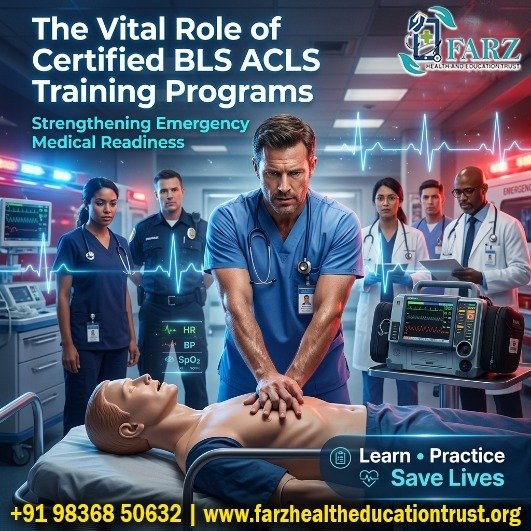
The Vital Role of Certified BLS & ACLS Training Programs in Strengthening Emergency Medical Readiness
Meta Description: Learn how certified BLS and ACLS training programs strengthen emergency medical preparedness by equipping doctors, nurses, and healthcare professionals with essential lifesaving clinical skills.
In emergency and critical care situations, the difference between life and death often depends on immediate, competent action. While India has a vast network of healthcare professionals, standardized and continuously updated emergency response training remains essential to improving patient survival outcomes. This is where certified BLS and ACLS training programs play a crucial role.
Beyond Basic CPR: Why Advanced Clinical Skills Matter
Basic Life Support (BLS) and Advanced Cardiovascular Life Support (ACLS) are more than professional certifications—they are foundational components of emergency medical preparedness.
BLS training focuses on essential, non-invasive lifesaving techniques such as high-quality CPR, airway management, and emergency response fundamentals. ACLS training builds upon these skills by covering advanced airway management, pharmacology, cardiac rhythm interpretation, and evidence-based protocols for cardiovascular emergencies.
For medical students, junior doctors, nursing professionals, and paramedics across India, these certifications are increasingly becoming essential for clinical excellence.
Whether working in a busy metropolitan hospital in Kolkata or serving patients in rural healthcare facilities, certified professionals can confidently follow standardized protocols, reducing response time, minimizing errors, and improving patient outcomes during critical situations.
Farz Trust’s Commitment to Certified Clinical Excellence
Farz Health and Education Trust delivers structured, certified BLS and ACLS training programs designed around the real-world medical challenges and healthcare demands of the region.
Our training emphasizes practical learning through high-fidelity simulations, scenario-based exercises, and hands-on clinical practice that transform theoretical knowledge into confident action during emergencies.
By providing clinical training for junior doctors, nursing professionals, and healthcare staff, we contribute directly to strengthening emergency medical preparedness across healthcare institutions and communities.
A strong emergency response ecosystem requires every member of the healthcare team—from first responders to specialists—to communicate and act using standardized protocols. By promoting globally recognized medical certification standards such as BLS, ACLS, and CPR, we help build a more coordinated and resilient healthcare system.
Healthcare professionals may also review nationally recognized resuscitation guidelines and clinical protocols through relevant professional and regulatory bodies.
Building Stronger Communities Through Emergency Preparedness
Investing in lifesaving skills training is ultimately an investment in community resilience.
Every healthcare professional trained through certified emergency response programs becomes better equipped to respond confidently when every second matters.
Supporting structured emergency training programs ensures that hospitals, clinics, and communities are better prepared for medical emergencies today—and stronger healthcare systems tomorrow.
Call to Action
Help build a future where every emergency receives a skilled response.
Whether you are a healthcare institution, corporate organization, educational partner, or individual supporter, your contribution can directly strengthen emergency preparedness within communities.
Partner with Farz Health and Education Trust to support certified BLS and ACLS training initiatives and empower healthcare professionals with critical lifesaving skills.
Contact us today to sponsor a training cohort, collaborate on healthcare education initiatives, or learn more about our emergency training programs. Together, we can create faster responses, stronger healthcare systems, and save more lives.
